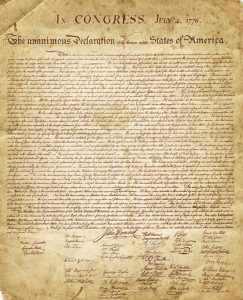
The Declaration of Independence
While doing some research the other day I ran across an interesting article written over 100 years ago by none other than Calvin Coolidge,[1] the man who became our nation’s 30th president when Warren Harding died in office in 1923. I’ve never been especially interested in Coolidge, but it was the article’s title, “The Purpose of America”, that caught my attention. In his article Coolidge states:
“Nations do not come into existence without a purpose…”
Well, that makes sense. He then goes on to state his conception of our nation’s purpose:
“In the fullness of time America was called into being under the most favoring circumstances, to work out the problem of a more perfect relationship among mankind that government and society might be brought into harmony with reason and with conscience. The great events and the great men of our country are those that have made the largest contribution to this purpose. The method by which men have always advanced this cause, the only method by which they ever can advance it, is through service and sacrifice. There can be no great people who are not willing to dedicate themselves to this high purpose.”
As you can see, according to Coolidge the United States was founded to facilitate government and society being brought into a better, more harmonious relationship, one that exhibits reason and conscience. While that sounds flowery and high-flown, I’m not sure I agree. I think our nation’s purpose is much more simply stated. As Jefferson wrote in the Declaration, that purpose is described within the famous line:
“We hold these truths to be self-evident, that all men are created equal, that they are endowed by their Creator with certain unalienable Rights, that among these are Life, Liberty and the pursuit of Happiness. That to secure these rights, Governments are instituted among Men, deriving their just powers from the consent of the governed.”
As far as our national purpose is concerned, that is what was agreed upon by the Colonies during the Second Continental Congress in July, 1776[2]—the moment of our nation’s creation.
Eleven years later, in 1787, that purpose was expanded upon in the Preamble to the Unites States Constitution:
“We the People of the United States, in order to form a more perfect Union, establish Justice, insure domestic Tranquility, provide for the common defense, promote the general Welfare, and secure the Blessings of Liberty to ourselves and our Posterity, do ordain and establish this Constitution for the United States of America.”
I don’t think the Founders, in these two documents, could have been much clearer. The purpose of our country, the United States of America, is the securing and protection of our rights and freedoms. And just to put it in concrete, they went ahead and etched the fact in stone with the Bill of Rights, defining forever the specific freedoms and rights to be protected and secured. These rights and freedoms are the basic elements in defining Justice in our nation; in what constitutes the general Welfare, and are what our Government is obligated to defend, both internally and externally. When you get right down to it, based on the nation’s founding documents, that’s what our nation’s purpose factually is.
Coolidge was right in stating that nations do not come into existence without a purpose. But that’s true of not only nations—it’s true of all groups. It applies to huge businesses like Amazon, and small ones like the corner grocery store. It applies to churches and civic groups; it applies to sports teams. An agreed upon purpose is the factor around which a group coalesces, and is the glue that binds it together. This is so much the case, that if you were called in to a group or business as a consultant to help it do better, just about the first thing you should do is get a clear statement of that group’s purpose. What is it attempting to do or accomplish? This is best done by asking the founder of the group, if they are still alive, or by talking to those who knew and worked with the founder, or by examining his writings and documents. However it is done, the first task of someone called in to help a struggling group is to divine its purpose.
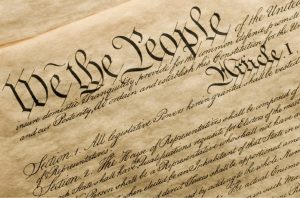
The United States Constitution
The next step, if you wanted to help the group or organization, is to establish, based on the now known and understood purpose, what this group SHOULD be doing and how it WOULD look, IF it was accomplishing and performing its purpose. This is called envisioning or working out the group’s “Ideal Scene.”[3] A properly established Ideal Scene for a group will always be a reflection of that group or organization’s purpose. The importance of doing this step is grasped when one understands this basic fundamental: that in order to evaluate something one must have a COMPARATIVE. This is essential, and is a big part of how one thinks. To evaluate anything requires something to compare it to. In the case of a struggling, unproductive group or organization, the comparison occurs by observing its existing scene against its Ideal Scene. In the process the group’s weak points, shortcomings and sour areas become apparent. By then investigating these weak spots; discovering and handling the reason for them, the group or organization is advanced toward its Ideal Scene.
Now, let’s apply all this to our country, the United States of America. Based on its defined purpose, what would its Ideal Scene look like? It would include its people enjoying the freedom to pursue their goals and purposes in life, as long as doing so did not infringe the rights of others. Thus, U.S. society would be very productive, with a high standard of living. It would include people being free to worship (or not) as they please in the church/religion of their choice; to speak their mind and publish their views, so long as they weren’t slandering others with false reports. Thus, our society would be tolerant, accepting of (not agreeing with necessarily) divergent opinions, different races and religions. Such a country would obviously be attractive to people in other nations and they would want to come here, but it would not be in the fashion happening now, which is unregulated and damaging to our communities, resources and national security. In the ideal scene immigration laws would be followed and illegal entry not allowed. International relations would emphasize diplomacy heavily in favor of military force, and the U.S. would not involve itself in the internal affairs of other nations, instead respecting their sovereignty. Sound economic/tax policies would be followed that facilitate production instead of impairing it. These are just some of the aspects of the envisioned Ideal Scene for our nation.
That our society has never in its history completely lived up to this envisioned Ideal Scene is not the point of this article. The point is that by comparing what we see in our existing scene to this ideal we can find the right reason for and work to correct the weaknesses. As part of the U.S. existing scene we have witnessed government endorsed censorship of alternate scientific views on the pandemic and vaccines, and the government induced censoring of private citizens by social media; we have witnessed the attempted overriding of the power of choice of individual citizens regarding their health care choices and the domination of the health care system by the pharmaceutical companies, even as people are becoming less healthy; we have seen our southern border with Mexico become a sieve, in violation of U.S. law, and the attendant massive influx of illegal drugs; we have seen the insinuation of Marxist oriented critical race and LGBQT theories into educational curriculums, even as early as grade school, and in defiance of the wishes of parents. Educational standards have declined and economically we are seeing double digit inflation resulting in rising prices making it harder for citizens to live, work and produce, while the national debt is exploding. Internationally, as with Ukraine, bellicose actions are endorsed instead of diplomacy, pushing our nation toward war. Many more examples exist and they all should be investigated, the unsuspected reasons for them found and a handling implemented to help our nation return more to the envisioned ideal.
Taken as a whole, the above just mentioned presents an overwhelming scene. It’s as if our nation is under attack from many quarters, and is at war. And, indeed, it is, though not a war in the classic sense. It’s a new kind of war, employing new tools and strategies—the tools and strategies of Cultural Destruction—and while most Americans can sense something is wrong, they are not able to spot the source, creating a dizzying, frustrating and dismaying scene.
Which brings us to the purpose of this Countering Cultural Destruction project, as described in this website and just released book. As you can discern from our project title, our purpose is to raise the awareness of our fellow citizens by isolating, investigating and disclosing the sources of cultural attack on the United States leading to effective handlings and measures to counter them.
Our goal, what we want ultimately, is a nation and government free from covert cultural attack and restored to its original purpose of securing and protecting our natural rights as citizens.
If you want that too, we invite you to join us and help us create a new birth of freedom in the United States of America.
Copyright©2024
by Mark Arnold
All Rights Reserved
________________________________
[1] Calvin Coolidge (born John Calvin Coolidge Jr. July 4, 1872 – January 5, 1933) was an American attorney and politician who served as the 30th president of the United States, from 1923 to 1929. Born in Vermont, Coolidge was a Republican lawyer who climbed the ladder of Massachusetts politics, becoming the state’s 48th governor. He served as vice president under Warren G. Harding from 1921 until 1923, when he assumed the presidency due to Harding’s death, and was elected as president in his own right in 1924.
[2] The Second Continental Congress was the late 18th-century meeting of delegates from the Thirteen Colonies that united in support of the American Revolution and the Revolutionary War, which established American independence from the British Empire. The Congress constituted a new federation that it first named the United Colonies, and in 1776, renamed the United States of America. The Congress began convening in Philadelphia, on May 10, 1775, with representatives from 12 of the 13 colonies, after the Battles of Lexington and Concord
[3] The information in this article regarding “Ideal Scenes”, “Existing Scenes” and the process of evaluation requiring a comparative is part of a precise investigatory technology developed by L. Ron Hubbard, Founder of Dianetics and Scientology, and is available in his writings.